

FAQs — Boarding Up West London (W2–W14)
If you’re looking at this page, something has probably happened — a break-in, a smashed window, storm damage, or you’ve been told you need to secure a property quickly. These FAQs cover how boarding up works in West London, what to expect when you call, and how we help you stay secure while repairs are arranged.
If you need urgent help, go straight to our emergency boarding up page or call us now.
Quick help: the essentials
- Phone: Call 020 4634 8072
- Email: [email protected]
- Coverage: West London across the W postcode area (W2–W14) — see areas we cover
- What we do: secure broken or vulnerable openings with boards, temporary steel doors, or steel security screens — see what is boarding up
Emergency boarding up (out of hours, same day, urgent)
Do you offer 24-hour emergency boarding up in West London?
Yes — we provide emergency boarding up across West London, including the W postcode area. If your property is exposed (broken glazing, forced door, damaged shopfront), securing it quickly helps reduce theft risk and weather damage.
We don’t promise fixed arrival times because traffic, access and the severity of the job vary, but we prioritise genuinely urgent calls.
Who should I call first — the police, my insurer, or a boarding-up company?
It depends on what’s happened:
- Burglary/break-in or vandalism in progress: call 999.
- After a break-in: call 101 if you need to report it and get a crime reference number.
- Then: arrange securing, especially if windows/doors are compromised. Our burglary repairs and boarding page explains what usually happens next.
- Insurer: it’s often best to notify them early. If you need paperwork for a claim, we can help with documentation — see insurance claims support.
If you’re unsure, call us and we’ll tell you what information we need to get the property secured safely.
Can you board up tonight?
If you need urgent help, we can often attend out of hours. Call 020 4634 8072 and explain what’s happened (window, door, shopfront, roof/skylight) and whether the site is safe to access.
What information should I have ready when I call?
If you can, have:
- The address and postcode (W2–W14)
- What’s damaged: window/door/shopfront/rooflight
- Rough size/number of openings
- Whether the property is occupied, vacant, or a commercial premises
- Any access notes (entry via side gate, concierge, rear mews, shutters, basement lightwell)
- If relevant: police incident/crime reference number
- Photos (only if safe)
This helps us arrive with the right materials and fixings.
Services: windows, doors, shopfronts, roofs
What types of boarding up do you provide?
We offer a range of boarding-up and securing options depending on the risk level and how long you need the property protected:
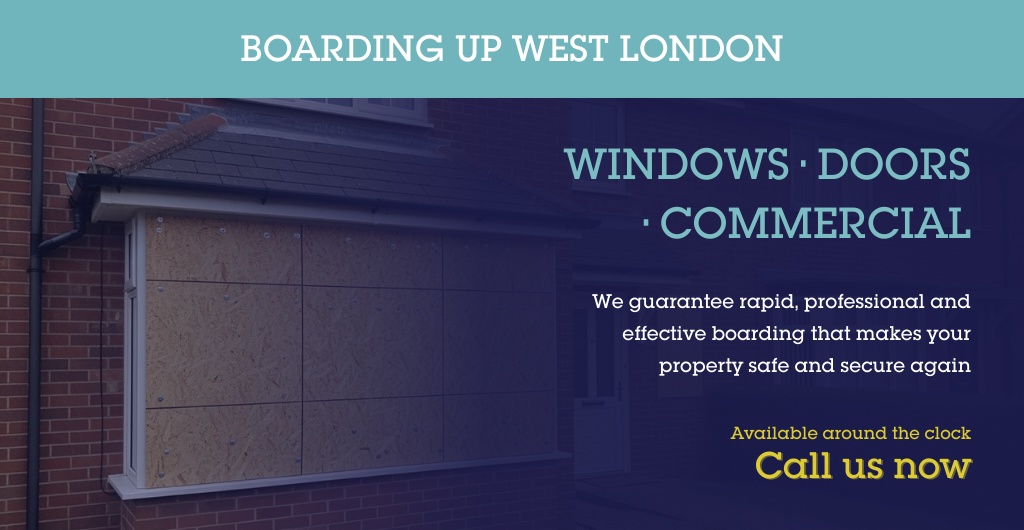
- window boarding in West London for broken or vulnerable glazing
- door boarding when doors are damaged or unsafe
- shopfront boarding for commercial glazing and retail frontages
- roof boarding for rooflights, skylights, or storm openings
- Security add-ons like temporary steel doors and steel security screens for higher-risk or longer-term situations
If you’re not sure which you need, describe the damage — we’ll recommend the safest option.
What materials do you use — plywood or OSB?
We typically use exterior-grade plywood for many openings because it’s strong and resists flexing and impact well. OSB (oriented strand board) can also be appropriate for certain sizes and situations.
As a rule of thumb:
- 18mm plywood is common for ground-floor windows and doors where impact resistance matters.
- 12mm OSB can be used for smaller or lower-risk openings where appropriate.
We choose the material based on opening size, fixing method, exposure to weather, and whether the property will be left unattended.
Do you board up from the inside or the outside?
Where possible, we prefer methods that are secure and minimise damage. The choice depends on the opening, access and the condition of the frame:
- Internal fixing can be effective when access is safe and frames are sound.
- External fixing may be necessary for shopfronts, large openings, or where internal access isn’t possible.
If the frame is too damaged for a non-destructive method, we’ll explain the options before proceeding.
Can you secure a door that’s been forced open?
Yes. After a forced entry, the door leaf, frame, locks, and keeps can all be compromised. We can provide door boarding or fit a temporary steel door where appropriate — particularly for vacant properties, repeated targeting, or where the doorway needs stronger medium-term security.
Can you board up a shopfront or large commercial window?
Yes. Commercial glazing often involves large panes, aluminium framing, and high footfall — especially in busy West London areas. Our shopfront boarding service focuses on:
- Strong sheet materials sized to the opening
- Fixings designed to resist removal from the outside
- A tidy finish that keeps staff and the public safer around the frontage
If you’re a facilities manager or landlord, we can also provide supporting paperwork for your records.
Do you board up rooflights and skylights?
Yes — rooflights, skylights and other overhead openings are common after storm damage or impact. See roof boarding for what’s involved, including safe access, weatherproofing priorities, and securing the opening until a roofer or glazier can carry out permanent repairs.
Situations: burglary, storm damage, fire, flood, accidents
What should I do after a burglary if my window or door is damaged?
If safe to do so:
- Don’t touch anything that could be evidence.
- Report it and obtain a crime reference number.
- Take photos (again, only if safe).
- Arrange securing as soon as possible.
We regularly attend post-incident call-outs — see post-burglary boarding and repairs for practical guidance on what happens next.
Can you help after vandalism or a smashed window?
Yes. Vandalism can range from a single cracked pane to repeated attacks. We can board up vulnerable windows or shopfronts and advise on stronger options if the property is likely to be targeted again. More details are on our vandalism repair and boarding page.
Do you board up after storm damage?
Yes. West London sees its share of high winds, fallen branches, and dislodged roof materials — especially around taller streets and exposed rooflines. Our priority after storms is making the property weather-tight and secure. See storm damage boarding for what to do first and how we help.
Do you attend fire-damaged properties?
We can secure the property after a fire where windows, doors or roof openings are compromised. We’re not a fire restoration company, and we don’t handle smoke/odour remediation — our focus is securing access points and reducing further risk. Read more on fire damage securing and boarding.
What about flood damage — can a property still be boarded up?
Yes, but flood damage can affect frames and doors (swelling, warping), and sometimes properties need ventilation as they dry out. We’ll talk you through the best way to secure the opening while keeping the building safe. See flood damage boarding.
Can you secure a property after an accident or impact?
Yes — for example, if a vehicle strikes a wall/shopfront or a large pane is shattered. If there are structural concerns, we may advise you to involve the building owner, insurer, or an engineer, but we can usually still secure exposed openings quickly. See accident damage boarding.
Costs, quotes, and what affects pricing
How much does boarding up cost in West London?
Costs vary depending on:
- Size and number of openings
- Access (upper floors, rear access only, scaffolding requirements)
- Materials (plywood vs OSB; steel doors/screens)
- Fixing method (anti-tamper fixings, non-destructive options where possible)
- Whether it’s an emergency/out-of-hours call-out
- Commercial requirements (RAMS, site induction, permit-to-work)
We don’t publish fixed prices because every job is different, but we are transparent about what’s included. See pricing for the factors we use to quote.
Do you offer free quotes?
Yes — for planned work and many non-urgent jobs, we can provide a no-obligation quote based on photos and details, or a site visit where needed. For urgent call-outs, we’ll focus on getting the property secured and then provide clear documentation of what was done.
Insurance, documentation, and landlord/agent needs
Is boarding up covered by insurance?
Sometimes, yes — it depends on your policy and the circumstances (burglary, storm damage, accidental impact, etc.). We’re not loss adjusters and can’t confirm cover, but we can provide the paperwork insurers typically ask for. Start here: insurance claims help.
What paperwork do you provide?
Typically, you can expect:
- An itemised invoice
- A statement of works (what we secured and how)
- Time-stamped photos before and after (where possible)
If you’re a landlord, agent, or facilities manager, this is often useful for audit trails and contractor records.
Do you work with landlords, managing agents and facilities teams?
Yes. We regularly secure:
- residential properties (flats, maisonettes, houses)
- commercial premises (shops, offices, restaurants)
- vacant properties between tenants, probate, or refurb
If you need repeatable processes (out-of-hours contacts, site access notes, keys held by concierge, etc.), let us know when you call.
Security, safety, and practical details
How long does boarding up take?
It depends on the number and size of openings and how complex access is. A single ground-floor window can be straightforward; a damaged shopfront or multiple openings takes longer, especially if frames are compromised.
When you call, tell us how many openings there are and send photos if possible — we’ll give you a realistic expectation.
Will boarding up damage my window frame or brickwork?
We aim to use secure methods that minimise additional damage, but the safest fixing method depends on what’s already broken and what material we’re fixing into. If the frame is rotten, split, or already shattered, we’ll talk you through the options before we proceed.
Can the boards be removed later for repairs?
Yes — boarding up is usually a temporary security measure while you arrange glazing, joinery or full repairs. If you need longer-term protection, we may recommend steel security screens or a temporary steel door rather than repeatedly re-boarding.
Do you provide temporary fencing as well?
In some situations — for example, if there’s been an impact and the area needs to be cordoned off — temporary fencing can help keep the site safe while repairs are arranged. See temporary fencing for details.
Do you dispose of broken glass?
If it’s safe and within scope, we can often make the area safer as part of the boarding-up work. However, extensive clearance, deep cleaning, or hazardous waste handling may require a specialist. If there are safety concerns on arrival, we’ll explain what we can and can’t do.
Areas covered (West London W postcodes)
Which areas do you cover?
We cover West London across W2–W14. For local pages, start at areas we cover. Examples include:
- boarding up in Bayswater W2
- boarding up in Ealing W5
- boarding up in Shepherd’s Bush W12
- boarding up in Kensington W8
- boarding up in West Kensington W14
If you’re close to the boundary and unsure, call — we’ll confirm.
Do you cover central areas like Oxford Street, Soho and Marylebone?
We cover parts of central London within the W area too, including locations like Oxford Street W1, Soho W1 and Marylebone W1. Access can be more complex (loading restrictions, high footfall), so it helps to tell us your nearest street and any delivery constraints.
Still have a question?
If you can’t find what you need here, contact us with a brief description of the damage and your postcode.
- Call: 020 4634 8072
- Email: [email protected]
- Or use our contact page
Helpful links
- emergency boarding up
- pricing
- insurance claims support
- window boarding in West London
- door boarding
- shopfront boarding
Ready to get started? Call 020 4634 8072 or email us for a free, no-obligation quote.
